

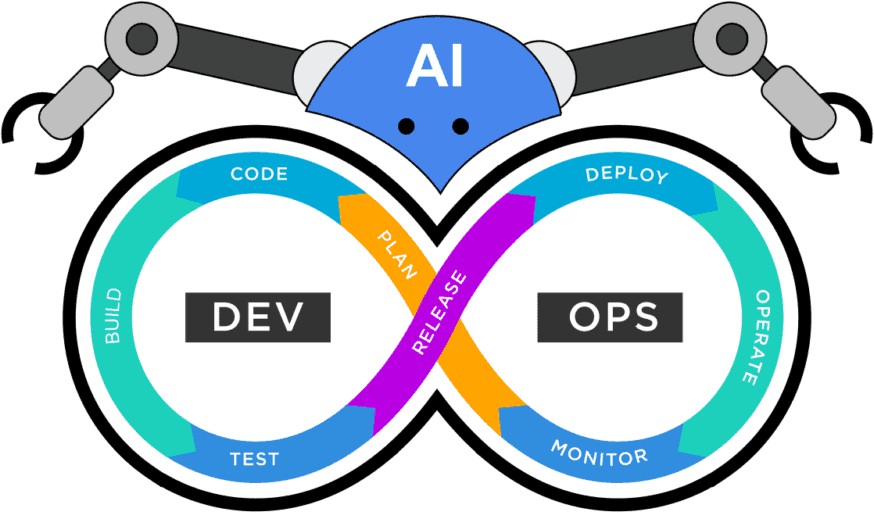
Artificial Intelligence (AI) and Machine Learning (ML) are transforming how businesses operate, innovate, and scale. But behind every successful AI or ML model lies a powerful backbone DevOps. As companies continue investing heavily in AI ML development services, the need for faster deployment, higher accuracy, and more scalable systems has become essential. This is exactly where DevOps comes into the picture.
Modern AI/ML systems are not just about coding algorithms—they require robust pipelines, automation frameworks, continuous integration, continuous delivery, quality checks, versioning, and monitoring. DevOps enables teams to streamline, automate, and accelerate the entire AI/ML lifecycle, reducing time-to-market and ensuring
enterprise-grade reliability.
Companies like Codevian Technologies are leveraging DevOps-driven processes to deliver advanced, scalable, and production-ready AI ML development services for global clients.
Let’s dive deeper into how DevOps plays a game-changing role in AI/ML workflows.
Why AI/ML Projects Need DevOps?
Traditional software development already benefits greatly from DevOps—but AI/ML adds more complexity. Unlike standard applications, ML models must deal with:
- Large and constantly changing datasets
- Model training and retraining cycles
- Experiment tracking
- Hyperparameter tuning
- Infrastructure-heavy workflows
- Monitoring drift, accuracy, and performance
This is why modern teams use MLOps, a combination of Machine Learning + DevOps principles, to manage end-to-end operations. It ensures smooth, automated, and reproducible AI pipelines. Without DevOps practices, AI/ML projects often suffer delays, scalability issues, and inconsistent performance.
Automating the AI/ML Pipeline
Automation is the core of DevOps, and it becomes even more crucial in AI ML development services. A typical AI/ML project includes:
- Data ingestion
- Data cleaning
- Feature engineering
- Model training
- Model evaluation
- Deployment
- Monitoring
Manually executing these processes introduces errors and slows down the workflow. DevOps practices automate almost every stage:
- Automated data pipelines
- Automated model validation
- Automated testing scripts
- Automated deployments
- Automated model upgrades
This results in faster, more efficient development cycles and quicker iteration on high-performing models.
Continuous Integration & Continuous Delivery (CI/CD) for ML Models
CI/CD is a backbone of DevOps and plays a transformative role in AI ML development services. For ML systems, CI/CD includes:
Continuous Integration
- Automatically testing data pipelines
- Automatically training new models when data changes
- Checking code quality
- Validating new datasets
Continuous Delivery
- Deploying approved models to staging or production
- Managing multiple versions of models
- Rolling back models in case of failure
Using CI/CD pipelines ensures that AI/ML models are always updated, validated, and deployable with minimal human intervention.
Codevian Technologies integrates CI/CD frameworks to ensure faster delivery and improved reliability of AI ML development services.
Infrastructure as Code (IaC) for Scalable AI/ML Systems
AI/ML tasks demand heavy computing resources—GPU clusters, distributed systems, cloud environments, and containerized workloads. DevOps solves infrastructure challenges using Infrastructure as Code (IaC) tools like:
- Terraform
- AWS CloudFormation
- Azure ARM
- Ansible
IaC helps automate:
- Setting up compute clusters
- Managing cloud environments
- Scaling training and inference infrastructure
- Ensuring reproducibility of experiments
This leads to cost savings, consistency, and rapid deployment.
Containerization with Docker & Kubernetes
Containers are essential for scaling AI/ML models. DevOps uses:
- Docker for packaging ML models
- Kubernetes for orchestrating model deployment
Benefits include:
- Environment consistency
- Faster deployment of ML models
- Auto-scaling model inference
- High availability and fault tolerance
- Isolation of different models
AI ML development services that rely on containers offer superior performance, security, and scalability.
Codevian Technologies uses Kubernetes-based deployments to ensure enterprise-grade reliability for AI/ML applications.
Monitoring ML Models in Production
Once deployed, ML models can degrade because:
- Data patterns change
- Concept drift occurs
- System load increases
- Models become outdated
DevOps monitoring tools help track:
- Model accuracy
- Latency
- Error rates
- Prediction quality
- Resource utilization
Continuous monitoring ensures AI/ML systems remain accurate, stable, and efficient.
Experiment Tracking & Version Control
AI/ML requires tracking experiments across:
- Datasets
- Hyperparameters
- Model architectures
- Code versions
- Results
DevOps integrates tools like MLflow, DVC, Git, and Weights & Biases to ensure:
- Complete reproducibility
- Transparent experiment history
- Easy collaboration
- Faster model improvements
This dramatically enhances the value of AI ML development services by enabling innovation with organized workflows.
Collaboration Between Data Scientists & DevOps Engineers
DevOps encourages cross-functional collaboration, which is critical for AI/ML success. Data scientists focus on experimentation, while DevOps engineers focus on automation, infrastructure, and deployment.
Together, they create:
- Reliable pipelines
- Faster releases
- Better model governance
- Smooth production integration
This collaboration eliminates the traditional “development vs. deployment” gap.
Security & Compliance in AI/ML Workflows
AI/ML deals with sensitive data—financial, personal, medical, and operational. DevOps enhances security with:
- Automated vulnerability scanning
- Secure access controls
- Compliance checks
- Data encryption
- Audit trails
Using DevSecOps principles, AI/ML systems remain safe, compliant, and trustworthy.
How Codevian Technologies Uses DevOps for AI/ML Excellence
Codevian Technologies is a leading provider of AI ML development services, delivering scalable and automated solutions across industries. Their DevOps-driven approach ensures:
- Faster AI/ML deployment cycles
- Automated pipelines for consistent results
- Scalable cloud and microservices architecture
- High-accuracy models with continuous monitoring
- Cost-efficient infrastructure automation
- Secure and enterprise-grade AI/ML implementations
By integrating DevOps and MLOps practices, Codevian enables businesses to transform data into actionable intelligence with maximum efficiency.
Conclusion
DevOps is no longer optional in the world of AI ML development services—it is a necessity. It streamlines workflows, automates pipelines, improves model quality, ensures continuous integration and monitoring, and ultimately enables organizations to scale AI-powered systems with reliability and speed.
Businesses that adopt a DevOps-first approach for AI/ML see:
- Faster time-to-market
- Higher model accuracy
- Better resource utilization
- Improved scalability
- Stronger security and compliance
With companies like Codevian Technologies offering DevOps-enabled AI ML development services, organizations can confidently build and deploy production-ready AI systems that drive growth and innovation.